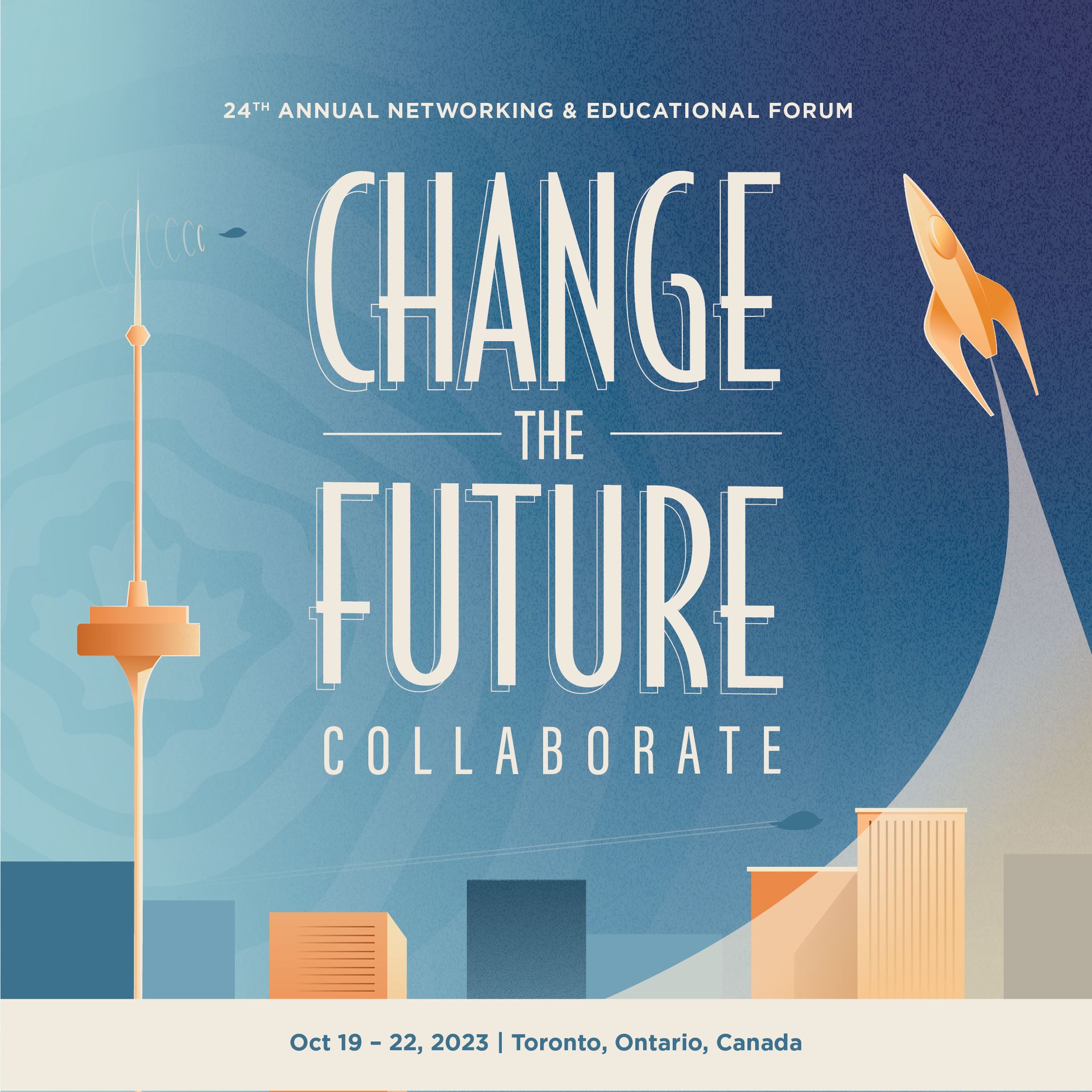
24th Annual Networking & Educational Forum: Change the Future Collaborate

The International Academy of Collaborative Professionals (IACP) was held on October 19 – 22, 2023 at the Westin Harbour Castle in Toronto, Ontario, Canada and was a huge success. This is a time where IACP members around the globe come together on a yearly basis to share new ideas and thoughts on how “we” as a united community can spread the word of collaboration. It is a time for us to share, grow and learn from our fellow colleagues. However, exciting changes are in the forefront for IACP. 

CHANGES

What exactly is change? Change is defined as undergoing transformation, transition, and substitution. With that said, one change that IACP is instilling is that there will be no future gatherings as traditionally done in the past. Rather, IACP will commence regional conferences around the world. Moreover, on the IACP’s website, one will be able to click on a pin on a map for dates, times, and registration links. Although change can be hard for many, change is a good thing with the right, forward-thinking vision, and with the right team.  Brian Galbraith, LL.B., IACP President turned over the reign to IACP’s new President, Julia McAninch, Psy.D who shared exciting news of IACP’s future happenings. Julia expressed her gratitude to Brian for his mentoring in preparation for her new role.  Brian successfully weathered the storm that impacted IACP due to the unprecedented Covid pandemic worldwide and all members were and still are very appreciative for his exceptional leadership skills. IACP continues to forge ahead to bigger and better things in the future.

BENEFITS

Some of the benefits that IACP offers are:

  1. Strides being made for further international growth and alliances around the globe. 
  2. Learning about different Collaborative trainings to further strengthen Collaborative practice groups worldwide.
  3. Growth in training for professionals by Collaborative trainers from a broad spectrum of locations to choose from.

And, so much more.

NETWORKING

The forum allowed for many networking events giving the members time to catch up not only professionally, but also on a personal level. Collaboration is all about persons working together especially in an intellectual endeavor. IACP takes it to a whole new way making each and everyone feel like they are part of a bigger and better way in life. It’s almost like we are all one big happy family. Many members were so excited to finally meet in person people they had been communicating with only virtually. Others made new friends and learned about how Collaborative law is practiced in other countries.  One of the beauties of collaboration is that it allows for interdisciplinary teams to come together from all parts of the world and be creative in helping resolve differences. Currently, the IACP members around the world include: Australia, Austria, Bermuda, Brazil, Canada, Chile, Czech Republic, Germany, Hong Kong, India, Ireland, Israel, Italy, Japan, Malaysia, Netherlands, New Zealand, Panama, Singapore, Spain, Switzerland, United Arab Emirates, United Kingdom, United States, and growing. Independently we make small differences, but together we form strong alliances and trigger big change.

EDUCATIONAL FORUMS

IACP’s Keynote speaker was Dr. Brian Goldman and his presentation was very insightful for many. Using the analogy of a group of medical professionals to explain the importance of collaboration. Dr. Goldman also spoke about how games can foster stronger relationships amongst professionals. Imagine that, something as simple as a team-building game can generate unity and collaboration.

It is not uncommon for many professionals to give generously of their time as presenters at these forums. The presentations ranged from a broad array of collaborative topics. In specific, the “Creating and Maintaining a Successful Practice Group: Leadership Skills for Practice Group Leaders” workshop was presented by Loretta Gephart, M.A. and Ross M. Evans, Esquire.  They empowered different Practice Group Leaders with knowledge, practical skills, and resources to further advance their leadership abilities and facilitation of their Practice Group growth. The end goal was to be able to take small nuggets from these presentations and take it home with you to apply it in your professional practice. What’s even better is that members were always open and willing to help each other when needed.  For example, being able to pick up the phone and make a quick call to ask for help on a difficult issue in a case. Truly a “win-win” for all.  Most importantly, the ability to foster deep connections with other like-minded Collaborative professionals while igniting change is mind-boggling. 

SPECIAL HIGHLIGHTS AND THANKS

During one of the gatherings, special accolades were given to Kevin Scudder, Collaborative Lawyer, may he rest in peace. All the members stood up in his honor and sang a song in his memory which gave rise to many heartfelt emotions.  To top off the forum, a fun-filled night generated a lot of laughter and dancing to live music while enjoying a cross culture of foods for dinner. What better way to finish off the IACP’s forum and capture memories for a lifetime. Join us as we travel around the globe, in a whole new way!

Special thanks to Dolores Puppione, Jasmine Polk, Lynda Robbins, and Shannon Grossi and others for their unwavering support in making sure everything ran smoothly throughout the Forum. And, when a request was made, without hesitation they were ready to provide exceptional service.

SO, WHAT’S NEXT?

If you’re ready to move forward to resolve your conflict in a respectful, dignified, and private way with a team of international Collaborative professionals reach out for more information at: https://www.collaborativepractice.com/. And, if you need a team of Spanish-speaking Collaborative professionals, visit: http://www.hispanocollaborativepros.com or email: info@collaborativeprofessionalpros.com.

Betsy Vázquez is the Founder of Vázquez Law, Mediate4Peace, and President of Hispano Collaborative Professionals™ (HCP) practice group.  She is a Collaborative Family, Estate Planning Before, During, and After Divorce, Elder Law Lawyer, Personal Family Lawyer®, Qualified Parenting Coordinator, and a Florida Supreme Court Certified Family and County Mediator.  Betsy is a native Floridian of Hispanic descent, mother, and dedicated to helping others resolve conflict in a better and healthier way. To reach Betsy visit: www.bvazquezlaw.com or call 305.440.1888 (1+ United States).
By William Hogg LL.M June 10, 2026
Reflection from William Hogg LL.M: I am writing this on the flight back to London, which probably explains the slightly scattered nature of what follows. I have just spent three days in Basel and I am still letting it all sink in. I had been looking forward to this conference for a long time. It did not disappoint. Basel was a wonderful setting, and the programme gave us a lot to think about. There were moments where the quality of discussion really stood out, not because it felt overly polished, but because people were speaking from experience. From 4th to 6th June, I joined professionals from across Europe for a conference on ethical challenges in Collaborative Law and Practice, hosted by Collaborative Law & Practice Switzerland together with the European Network for Collaborative Practice . As a board member of the ENCP, and of the Family Mediators Association here in the UK, this is a community I have been part of and championed for years. Being in Basel with so many of its members in person was a genuine pleasure. Lawyers, mediators, financial advisers and coaches. People who spend their working lives with families at the worst moments those families will ever face. There was something unusual about being in a room like that. Everyone seemed to be there for the same reason, and it was not really a commercial one. They wanted to know how to do this work better. How to cause less damage. How to help people get through separation with a bit more of their dignity intact. That is what I have come away thinking about most. We tend to talk about family law in technical language. Disclosure, negotiation, orders, hearings, outcomes. All of it matters and none of it is going away. But underneath every one of those words is a person who is frightened, grieving, or watching a future they had planned for simply dissolve. Collaborative Practice starts from that fact rather than working around it. It asks us to care about how someone arrives at the answer, not only what the answer is. For anyone who has not come across it, Collaborative Law is a structured way of resolving family matters without going to court. The clients and their advisers agree to work things out around a table. It relies on honesty, good preparation, and a genuine willingness to solve the problem instead of trying to win. That idea is not new. What felt new in Basel was how hard people are now pushing on the detail. How do you build a proper team around a client. How do you spot a power imbalance before it does harm rather than after. How do you let a child's voice into the process without putting a child in the middle of it. How do you adapt when the person across the table is anxious, neurodiverse, or so overwhelmed they can barely take in what is being said. These are not seminar questions. They are the things that actually decide whether a case goes well or badly. The ethics theme ran through all of it, and rightly so. In Collaborative work ethics are not a footnote. They are the foundation. If one person does not feel safe enough to speak honestly, the process has already failed, however civilised it looks from the outside. If the advisers lose sight of who they are really there to serve, the trust that holds everything together starts to go. A room can be perfectly polite and still be deeply unfair. The same point kept coming back in different sessions. Goodwill on its own is not enough. You need skill, you need structure, and you need to keep questioning yourself. You have to be confident enough to give your client proper advice, and disciplined enough not to throw petrol on the conflict while you do it. You have to ask your client to be open, while accepting that openness is only possible if you have built the conditions for it. That is the part I find genuinely exciting. The principles are old. The way the ENCP and its members are developing them across Europe feels very much alive. There is a real appetite to keep improving, to borrow from how other jurisdictions do things, and to keep asking the uncomfortable question of whether the process is actually helping the families who use it. I came away energised and proud to be part of this community. A special mention to some of the standout contributions over the three days. Shireen B. Meistrich from the US, was excellent, as were lawyers Marc Sheridan and Jacinta Gallant , and Alicia Farran of Our FamilyWizard in the UK. Federica Marabini , Michela Tonini and Sofia Tremolada gave a superb group presentation as a Collaborative team from Italy, and Swiss speakers Titus Thoma and Stefanie Santschi rounded things off beautifully. Thank you all. You are a large part of what made the three days so worthwhile. One thing I keep returning to is that Collaborative work refuses the assumption that separation has to be a fight. Plenty of cases do need a courtroom. Some clients need the protection that only a court can give, and I would never pretend otherwise. Collaborative Practice is not for everyone, and anyone who sells it as a cure for everything is overselling it. But for the right people it can change everything. It gives them somewhere to be supported without being backed into a corner. It lets the hard conversations happen with someone in the room to guide them. It nudges everyone to look past the argument in front of them and towards the life the family still has to live. That matters most when there are children. Two people might stop being a couple and still have to spend the next twenty years being parents together. How the legal process is handled can make that future a little easier or a good deal harder. So, I am grateful to the organisers for three genuinely valuable days, and reassured that there is a serious, thoughtful community of people across Europe who care deeply about getting this right. I am not bringing home one tidy lesson. It is more a reminder. Family law can keep evolving. An established process can still feel fresh when people apply it with imagination and a bit of care. And when professionals work together properly, with integrity and real concern for the person in the middle of it, the client is the one who benefits. That is how we try to think about family law at Laurus . The question is never simply what the legal route is. It is what the right route is for this client, this family and this particular moment in their life. Basel was a good reminder of why that question is the one that matters.
By Heather Theisen-Gandara May 3, 2026
A perspective on the three key areas in which divorce coaching adds value the broader ecosystem of divorce support and the Collaborative divorce process.
By Michael P. Sampson April 3, 2026
Learn more about the roots of Collaborative Practice which led to thousands of professionals globally help people resolve disputes respectfully out of court.
By Melissa Murphy Pavone April 3, 2026
This article explores how a proactive, team-driven approach can transform divorce from a reactive, adversarial process into a more intentional, amicable path forward.
By Ross Evans January 27, 2026
A blog about the role of practice group pods strengthening community in Collaborative Practice groups.
By Adam Cordover and Dr. Randy Heller January 8, 2026
Authors Adam B. Cordover and Dr. Randy Heller explain how teams around the globe can use the insights from a decade of survey data from Florida Collaborative matters
By Dr. Deb Gilman December 1, 2025
Twelve days. Two homes. One goal: giving your child a holiday season that feels safe, steady, and truly joyful.
By Ria Severance, LMFT November 19, 2025
Learn how a licensed mediating divorce specialists trained to collaborate – get you a cost-effective divorce that covers all your bases.
A woman is sitting at a table with her arms crossed and smiling.
By Dr. Randy Heller August 23, 2025
Kevin Scudder Higher Education Scholarship Fund, developed to carry on Kevin's legacy and train Law and Graduate students to become Collaboratively trained.
A blurred image of a website on a white background.
By Dr. Deb Gilman June 6, 2025
How the Collaborative Process (and a Good Child Specialist) Can Help Families Navigate Coercive Control and Still Show Up for the Kids